
 English
 русский
 عربى
عربى







Flagpoles stand as proud symbols, gracing homes, businesses, and public spaces alike. While various materials are used in their construction, stainles......
READ MORESubmit feedback
Home / News / Industry News / Outdoor Flagpole Guide:What Is a Flagpole Truck, How to Attach a Flag to a Flagpole Rope, Typical Heights, and Stainless Steel vs Aluminum Alloy Flagpoles Compared
Outdoor Flagpole Guide:What Is a Flagpole Truck, How to Attach a Flag to a Flagpole Rope, Typical Heights, and Stainless Steel vs Aluminum Alloy Flagpoles Compared
For a 30 foot flagpole, the correct flag size is 5 feet by 8 feet, following the standard guideline that flag length should be approximately one-quarter to one-third of the pole height. A flagpole truck is the pulley assembly at the very top of the pole through which the halyard (rope) runs, allowing the flag to be raised and lowered. To attach a flag to a flagpole rope, you use snap hooks (also called flag snaps) to clip the flag's grommets to the rope clips or loops on the halyard. Typical flagpole heights for residential use are 15 to 25 feet, for commercial and government sites 25 to 40 feet, and for large civic or institutional applications 50 to 100 feet or more. Between an Aluminum Alloy Flagpole and a Stainless Steel Flagpole, aluminum is lighter, cheaper, and the standard for most outdoor residential and commercial installations, while stainless steel is heavier and more expensive but offers superior corrosion resistance in coastal, marine, and chemically aggressive environments. This guide covers every practical dimension of selecting, installing, and maintaining an outdoor flagpole.
What Size Flag for a 30 Foot Flagpole and the Complete Flag-to-Pole Sizing Guide
The most important and most commonly misunderstood aspect of flag display is matching the flag size to the pole height. A flag that is too small looks lost and inconspicuous on a tall pole. A flag that is too large is overwhelmed by wind loading, deteriorates faster, and looks disproportionate. The standard rule used by flag manufacturers, the Flag Manufacturers Association of America (FMAA), and the US Government Printing Office is that the flag's fly end (length) should be approximately one-quarter to one-third of the flagpole height, with the flag's proportional width (hoist) following each flag's standard ratio.
The Standard Flag Sizing Formula Applied to Common Pole Heights
For the US flag, the official proportion is a fly (length) to hoist (width) ratio of 1.9:1, meaning a flag 8 feet long is approximately 4.17 feet wide (typically sold as a 5×8 or 4×6 with the nearest commercial size selected). The table below applies the one-quarter to one-third guideline across all common residential, commercial, and institutional pole heights:
| Pole Height | Recommended Flag Size | Alternative Size | Typical Setting |
|---|---|---|---|
| 15 feet | 3 × 5 ft | 2.5 × 4 ft | Small residential yard |
| 20 feet | 3 × 5 ft or 4 × 6 ft | 3 × 5 ft | Residential, small business |
| 25 feet | 4 × 6 ft | 3 × 5 ft or 5 × 8 ft | Residential, small commercial |
| 30 feet | 5 × 8 ft | 4 × 6 ft | Commercial, institutional |
| 35 feet | 5 × 8 ft | 6 × 10 ft | Commercial, government |
| 40 feet | 6 × 10 ft | 5 × 8 ft | Government, large commercial |
| 50 feet | 8 × 12 ft | 6 × 10 ft | Government buildings, airports |
| 60 feet | 10 × 15 ft | 8 × 12 ft | State capitols, large institutions |
| 100 feet | 20 × 30 ft or 15 × 25 ft | 20 × 30 ft | National monuments, major civic sites |
Why the 30-Foot Flagpole Calls Specifically for a 5×8 Flag
A 30-foot pole, divided by 4 gives 7.5 feet and divided by 3 gives 10 feet. The ideal fly length therefore falls between 7.5 and 10 feet. A 5×8 foot flag (8-foot fly length) sits perfectly within this range at approximately one quarter of the pole height. The 4×6 foot flag (6-foot fly) falls slightly short but remains acceptable as a minimum size. The 6×10 foot flag (10-foot fly) is at the upper end of the range and suits windier environments or situations where visual presence at a distance is the priority. For a private residence with a 30-foot pole in a suburban yard, the 5×8 foot flag is the most visually proportionate and the most widely recommended choice by retailers and flag etiquette guidelines.
Additional Sizing Considerations Beyond Pole Height
- Wind exposure: In consistently windy coastal or plains locations, using the smaller end of the recommended range (e.g., 4×6 on a 30-foot pole instead of 5×8) reduces wind loading, extends flag life significantly, and reduces stress on the halyard and truck assembly. A flag flying in sustained winds above 20 mph wears out approximately three to five times faster than in calm conditions.
- Multiple flags on one pole: When two flags are flown on the same pole (national flag above a state or organizational flag), each flag should be approximately the same size and proportional to the pole. The total area of both flags should not exceed what a single flag of the guideline size would present, which often means choosing one size smaller for each flag.
- Building facade vs. freestanding pole: Flags mounted on building-mounted or wall-mounted flagpoles use different sizing rules because the viewing distance and pole angle change the visual proportion. A wall-mounted pole extending 8 to 12 feet from a building typically pairs with a 3×5 foot flag regardless of the building's height.
What Is a Flagpole Truck and Why It Matters for Your Installation
A flagpole truck (also spelled "truck" in the flagpole hardware industry) is the fitting at the very top of a flagpole that contains one or more pulleys (sheaves) through which the halyard rope passes, allowing the flag to be raised and lowered. The truck is one of the most mechanically stressed components of any flagpole system, taking the full load of the flag in wind, the wear of constant rope movement, and exposure to weather without any shelter. A failing truck is the most common mechanical reason a flag cannot be properly raised or lowered on an outdoor flagpole.
Components and Construction of a Standard Flagpole Truck
A typical external halyard flagpole truck consists of:
- Housing (cap): The outer shell that sits on top of the pole, typically cast aluminum, injection-molded nylon, or machined stainless steel. The housing must match the pole's outer diameter precisely to seat correctly and prevent water infiltration into the pole interior. Standard residential and light commercial trucks are sized to fit poles from 2 to 5 inches outer diameter.
- Sheave (pulley wheel): One or two grooved wheels around which the halyard runs. Single-sheave trucks are standard for residential poles and allow one flag halyard. Double-sheave trucks allow two independent halyards, useful for flying two flags simultaneously (each on its own rope) or for running a continuous-loop internal halyard system on external halyard poles.
- Bushing or bearing: The sheave rotates on a central axle supported by a nylon bushing (standard) or sealed ball bearing (premium). Ball bearing trucks rotate with significantly less friction, reducing wear on the halyard rope and making it easier to raise and lower heavy flags or flags in high wind. Premium ball bearing trucks for commercial poles can cost $40 to $120 compared to $10 to $30 for standard nylon bushing trucks.
- Ornament cap: On many residential and commercial flagpoles, an ornament (ball, eagle, or spear finial) screws into the top of the truck housing, completing the visual appearance of the pole. The ornament is decorative but must be securely fastened to prevent it from loosening and falling from height. On poles above 30 feet, a fallen ornament presents a significant safety hazard.
Types of Flagpole Trucks by Halyard System
- External halyard truck: The standard type for most outdoor flagpoles. The halyard (rope) runs over the truck's external sheave, down the outside of the pole, and ties off at a cleat mounted on the pole shaft. External halyard systems are the easiest to operate, inspect, and maintain. The disadvantage is that the exposed halyard is subject to vandalism and the rope-slapping-pole noise in wind.
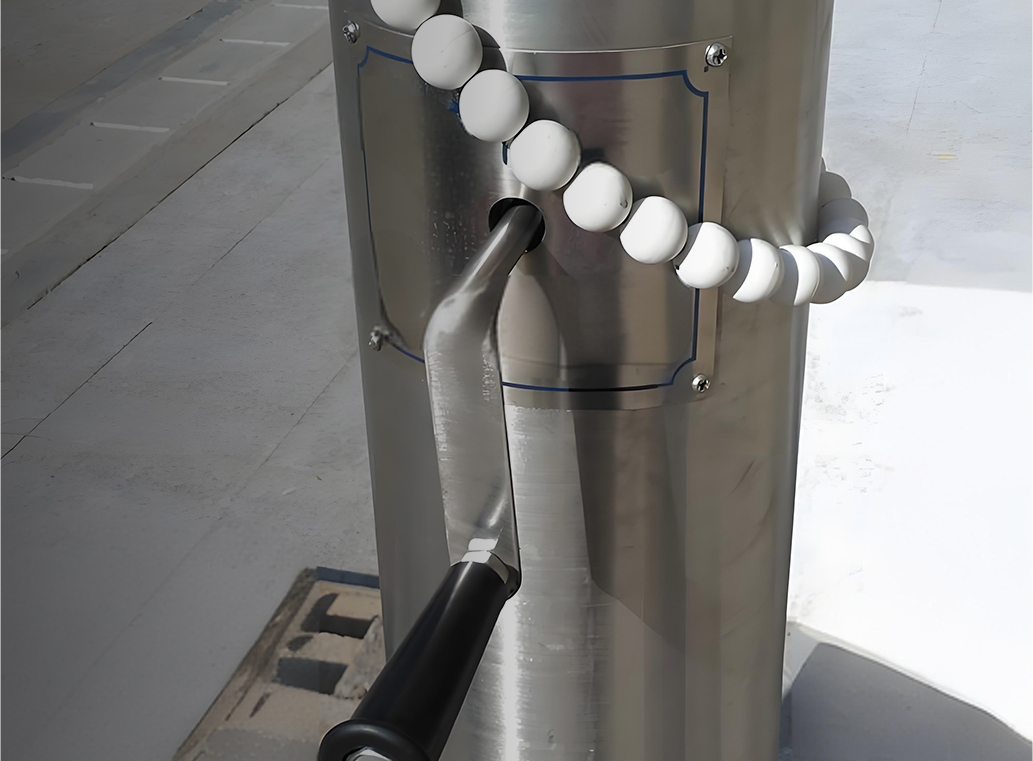
- Internal halyard truck: The halyard runs inside a hollow pole shaft to a locking mechanism at the base. Internal halyard poles are used in government, institutional, and high-security commercial settings where halyard vandalism (cutting the rope to bring down the flag) is a concern. The truck for an internal halyard system has a different geometry, with the rope entering through an opening in the base of the truck housing rather than running over an exposed sheave. These systems typically use a hand winch at the base rather than the hand-over-hand hauling technique used with external halyard poles.
- Revolving truck: A rotating ring is attached to the flagpole truck, allowing a flag to spin freely around the pole in wind. This prevents the flag from wrapping around the pole shaft in variable-direction winds, which is the most common cause of flag tangling on residential and commercial poles. Revolving trucks are significantly more effective than anti-wrap devices and are the recommended choice for any outdoor flagpole location that experiences frequent wind direction changes.
Maintaining and Replacing the Flagpole Truck
The truck should be inspected annually for the following conditions that require replacement:
- Cracked, chipped, or broken sheave that has created a rough surface wearing through the halyard rope rapidly
- Seized or stiff sheave that no longer rotates freely, causing the rope to slide over a stationary wheel rather than roll, accelerating rope wear
- Housing that has cracked or loosened its fit on the pole top, allowing the truck to shift under flag load
- Ornament that has loosened from the truck housing and cannot be re-secured with the original fastener
Replacing a truck requires either a telescoping ladder or a pole-climbing device for any pole above 20 feet. On poles above 30 feet, truck replacement is a professional service task using a bucket truck or certified pole climber.
How to Attach a Flag to a Flagpole Rope: Step-by-Step Instructions
Knowing exactly how to attach a flag to a flagpole rope correctly prevents the two most common flag attachment failures: the flag detaching from the halyard in wind (usually caused by improperly closed snap hooks) and the flag flying upside down (caused by attaching the snaps in the wrong orientation). The standard method for most residential and commercial outdoor flagpoles with external halyards uses snap hooks clipped to the flag's grommets.
Understanding the Parts: Grommets, Snap Hooks, and Halyard Hardware
- Grommets: Metal rings reinforced into the hoist edge (the left edge when the flag is displayed correctly) of the flag. Standard US flags have two grommets: one near the top edge and one near the bottom edge of the hoist. The grommets are what the snap hooks clip into.
- Snap hooks (flag snaps): Spring-loaded metal clips with a gate that opens to accept the grommet and snaps shut. Quality snap hooks for outdoor flagpoles are made from solid brass or 316 stainless steel with spring mechanisms that resist corrosion and accidental opening. Avoid zinc die-cast or chrome-plated steel snaps, which corrode rapidly and lose spring tension in outdoor environments.
- Halyard rope: The rope that runs through the truck and down the pole. On most residential and light commercial poles, the halyard is 5/16 inch (8 mm) braided polyester or twisted nylon. Polyester is preferred outdoors because it has minimal stretch and UV resistance superior to nylon. The snap hooks may be permanently spliced onto the halyard, or they may be attached to separate rope loops tied into the halyard at the correct spacing for the flag size.
Step-by-Step Flag Attachment Procedure
- Lower the halyard completely and bring the snap hooks to a comfortable working height. Do not try to attach the flag at arm's length above your head, as this makes it impossible to verify correct orientation and secure closure of the snaps.
- Identify the top of the flag. Lay the flag out on a clean, flat surface in its correct orientation. Verify that the union (blue field with stars) is in the upper left corner when the flag is laid flat with the hoist edge facing you. This is the edge that attaches to the halyard. The top grommet will be at the upper left, the bottom grommet at the lower left.
- Confirm snap hook spacing matches the grommets. The distance between the two snap hooks on the halyard should closely match the distance between the two grommets on the flag's hoist edge. A 5×8 foot flag has grommets approximately 5 feet apart. If your halyard snaps are at fixed positions that do not match your flag's grommet spacing, you will need to add rope loops or replace the snap hook placement to match the new flag size.
- Attach the top snap hook first. Open the gate of the upper snap hook and insert it through the top grommet of the flag, then release the gate so it closes fully. Pull lightly on the hook to confirm it is locked in the grommet and cannot be pulled free without manually opening the gate.
- Attach the bottom snap hook. Pull the lower snap hook down to meet the bottom grommet and attach it in the same manner. The flag should now hang from the two snap hooks with its hoist edge vertical and union at the upper left, facing away from the pole when flown.
- Orient the snap hooks so they face the same direction. The open side of both snap hook gates must face the same direction (both gates toward the pole, or both away from the pole — follow the flag or pole manufacturer's guidance). Mismatched snap orientations cause the flag to twist on the halyard under wind loading. Most installations have both hooks with gates facing the pole, so the hooks point away from the pole and the flag cannot be pulled off the snaps by outward wind force.
- Raise the flag briskly to the top of the pole in one smooth motion, as required by the US Flag Code for hoisting. Do not allow the flag to drag on the ground during raising. As the flag rises, keep light tension on the hauling end of the halyard to prevent the rope from looping around the flag.
- Secure the halyard at the cleat. Tie off the halyard at the cleat on the pole shaft using a cleat hitch (two full wraps crossing the cleat, with the final wrap a half turn that locks the rope without requiring a knot). A properly tied cleat hitch holds the halyard securely but can be released instantly with a single motion by lifting the final loop off the cleat horn.
Common Attachment Errors and How to Avoid Them
- Snap hook not fully closed: A gate that is partially closed rather than fully latched will release under wind-induced shock loads. Always pull firmly on the attached hook after closing to verify full engagement before raising the flag.
- Flag attached upside down: The union (stars) must always be at the top. An upside-down flag is a recognized distress signal under the US Flag Code and is a significant etiquette error in any other context. Always lay the flag flat and verify orientation before attaching.
- Snap hooks too far apart for the flag's grommet spacing: If the hooks are spaced further apart than the grommets, the flag will be stretched diagonally when raised, causing premature tearing at the grommets. Adjust the halyard rope loop positions to match the flag's grommet spacing exactly.
- Worn or corroded snap hooks: Replace snap hooks immediately if the spring no longer holds the gate closed under light pressure, or if corrosion has roughened the surface to the point where the hook scratches the grommet when opening and closing. Damaged hooks cause grommet wear that eventually tears the flag edge.
Typical Flagpole Height by Setting: Residential, Commercial, and Government
Typical flagpole height is determined by the visual setting, the size of the site, local zoning regulations, structural wind load requirements, and the intended flag size. There is no single universal standard, but there are well-established conventions used across residential, commercial, and government applications that make height selection straightforward in most cases.
Residential Flagpole Heights: 15 to 25 Feet Is the Standard Range
For private residences, a flagpole height of 15 to 25 feet is the accepted standard. The most common residential installation is a 20-foot pole, which is tall enough to display a 3×5 or 4×6 foot flag with good visual presence from the street while remaining manageable without professional installation for most homeowners. Key considerations for residential height selection:
- Zoning and HOA restrictions: Many municipalities have height limits for freestanding structures on residential lots. Heights above 25 feet may require a building permit, a zoning variance, or both in most residential zones. HOA governing documents frequently restrict flagpole heights to 20 to 25 feet and may specify materials or finishes. Check local regulations before purchasing any pole intended to be 20 feet or taller.
- Wind exposure: A 20-foot pole in a heavily wooded or sheltered yard can display a larger flag with less structural concern than the same pole on an exposed hilltop. The wind load calculation is the engineering foundation of any outdoor flagpole installation.
- Surrounding structures: The general guideline is that the flagpole should be tall enough for the flag to clear the roofline and nearby trees and be visible from the street, but not so tall that it is visually disproportionate to the residence. A 20-foot pole beside a single-story house is typically ideal; a 15-foot pole beside a two-story colonial may appear short. Increasing height to 25 feet alongside a two-story structure improves visual proportion.
Commercial Flagpole Heights: 25 to 40 Feet for Most Applications
Commercial properties including retail stores, office buildings, hotels, and industrial facilities typically install poles in the 25 to 40-foot range. A 30-foot pole with a 5×8 flag is the most common commercial installation in North America, providing strong visual presence from roadways and parking lots while remaining within the structural capacity of a standard commercial-grade ground-set aluminum pole without exceptional foundation engineering.
- Multiple pole installations: Commercial sites often install three poles side by side for the national flag plus state and corporate flags. In a three-pole grouping, the center pole is the tallest (typically by 2 to 5 feet) and flies the national flag, while the two flanking poles fly the state flag and corporate or organizational flag at equal height. All three poles should be the same diameter for visual consistency, even if different heights.
- Roadside visibility: For commercial properties on high-speed roads where the flagpole serves a marketing identification function as well as an etiquette function, taller poles of 35 to 40 feet with 6×10 foot flags provide greater visibility at approach distances of 500 feet or more.
Government and Institutional Heights: 40 to 100 Feet and Beyond
Government buildings, military installations, schools, universities, and civic landmarks use poles from 40 to 100 feet, with the largest installations at national monuments exceeding 100 feet. The US Capitol flag was historically flown on a 60-foot pole; Iwo Jima-style memorial installations and similar monuments use poles of 60 to 100 feet. At these heights, professional engineering for both the pole and foundation is essential, and the flag sizes grow correspondingly large (the current US flag flying over Fort McHenry, for example, is a ceremonial 30×42 foot flag).
| Installation Type | Typical Height Range | Common Flag Size | Typical Material |
|---|---|---|---|
| Small residential | 15 to 20 feet | 3×5 ft | Aluminum alloy |
| Standard residential | 20 to 25 feet | 4×6 ft | Aluminum alloy |
| Standard commercial | 30 to 35 feet | 5×8 ft | Aluminum alloy |
| Large commercial or government | 40 to 50 feet | 6×10 to 8×12 ft | Aluminum alloy or stainless steel |
| Institutional or civic | 50 to 80 feet | 10×15 to 15×25 ft | Aluminum alloy or fiberglass |
| National monument or landmark | 80 to 200 feet | 20×30 ft and above | Steel or high-strength aluminum |
Outdoor Flagpole Materials: Stainless Steel Flagpole vs Aluminum Alloy Flagpole
Choosing between a Stainless Steel Flagpole and an Aluminum Alloy Flagpole comes down to the operating environment, the required service life, the installation budget, and the structural load requirements. Both materials are widely used in outdoor flagpole applications, but they have fundamentally different performance profiles that make each the right choice in different situations.
Aluminum Alloy Flagpole: Properties, Alloys, and Why It Dominates Residential and Commercial Use
The Aluminum Alloy Flagpole is the standard choice for approximately 90% of all outdoor flagpoles installed in North America and most of the world. Its dominance comes from an outstanding combination of light weight, natural corrosion resistance, high strength-to-weight ratio, formability into the tapered profiles used in flagpoles, and cost that significantly undercuts steel alternatives. The specific alloy used matters significantly for performance:
- 6063-T6 aluminum: The most commonly specified alloy for commercial-grade flagpoles. It has a tensile strength of approximately 30,000 to 35,000 psi, excellent extrudability (allowing precise tapered profiles to be manufactured), and very good corrosion resistance. The T6 temper indicates solution heat-treated and artificially aged for maximum strength.
- 6061-T6 aluminum: Higher strength than 6063 (tensile strength approximately 40,000 to 45,000 psi), used in poles requiring greater structural performance (larger flags, higher wind zones, taller poles). Slightly less corrosion-resistant than 6063 in the absence of protective finishing.
- Surface finish options: The standard outdoor finish for aluminum flagpoles is an anodized coating (electrochemical oxidation of the aluminum surface to create a hard, corrosion-resistant layer typically 0.7 to 1.0 mil thick). Clear anodize gives a silvery appearance; bronze anodize gives a warm brown; black anodize gives a dark architectural finish. Factory-applied polyester powder coat is an alternative that provides a richer color range but may chip at impact points over time. Both finishes are expected to last 20 to 30 years in inland environments with normal maintenance.
Aluminum flagpoles for residential use are typically purchased in pre-assembled sectional form (two or three sections that telescope together) or as single-piece units for poles up to 25 feet. Commercial poles above 25 feet are almost always one-piece tapered extrusions for maximum structural integrity. A one-piece tapered 30-foot commercial aluminum flagpole weighs approximately 40 to 70 pounds depending on wall thickness and taper, making installation without mechanical equipment challenging but feasible with a crew of two to three people.
Stainless Steel Flagpole: Grades, Advantages, and When It Is Worth the Premium
A Stainless Steel Flagpole is significantly heavier, more expensive, and less commonly installed than aluminum but offers superior corrosion resistance in environments that degrade aluminum finishes prematurely. Stainless flagpoles represent a premium product category used primarily in marine, coastal, and architectural applications:
- Grade 304 stainless steel: Contains 18% chromium and 8% nickel. Provides excellent corrosion resistance in most outdoor environments but is susceptible to chloride-induced pitting in direct marine spray exposure or coastal environments within approximately 1 mile of salt water. Used in inland or moderately coastal architectural flagpole applications where the polished mirror finish is an aesthetic requirement.
- Grade 316 stainless steel: Adds 2 to 3% molybdenum to the 304 composition for significantly improved resistance to chloride pitting. The correct choice for marine-side installations, boat docks, coastal boardwalks, and any outdoor flagpole within direct salt spray range. Grade 316 stainless flagpoles are the standard for yacht clubs, beachfront hotels, coastal government installations, and offshore platforms.
- Structural performance: Stainless steel has a tensile strength of approximately 70,000 to 90,000 psi (yield strength), roughly double that of 6061-T6 aluminum. This allows stainless flagpoles to be manufactured with thinner walls for the same structural performance, partially offsetting the weight disadvantage of stainless vs. aluminum. However, the density of steel (7.9 g/cm³) vs. aluminum (2.7 g/cm³) means a stainless flagpole is approximately three times heavier than an aluminum pole of the same dimensions even with wall thickness reduction.
- Aesthetic qualities: A polished or brushed stainless steel flagpole has a distinctive high-end architectural appearance that anodized aluminum cannot fully replicate. Mirror-polished 316 stainless poles are used in upscale hotel entrances, corporate headquarters buildings, and luxury residential estates where the material finish is part of the intended visual statement.
Direct Comparison: Aluminum Alloy Flagpole vs Stainless Steel Flagpole
| Criterion | Aluminum Alloy Flagpole | Stainless Steel Flagpole |
|---|---|---|
| Typical weight (30 ft pole) | 40 to 70 lbs | 120 to 200 lbs |
| Typical purchase cost (30 ft) | $200 to $800 | $800 to $3,000+ |
| Marine corrosion resistance | Moderate (inland excellent; coastal degrades over time) | Excellent (316 grade) |
| Tensile strength | 30,000 to 45,000 psi | 70,000 to 90,000 psi |
| Surface finish options | Anodized (silver, bronze, black), powder coat | Mirror polish, brushed, satin |
| Expected service life (inland) | 20 to 40 years | 30 to 50+ years |
| Expected service life (coastal) | 10 to 20 years (with maintenance) | 25 to 40+ years (316 grade) |
| Installation difficulty | Manageable (light weight) | Requires mechanical assistance |
| Best application | Residential, commercial, government (inland to moderate coastal) | Marine, coastal, architectural premium installations |
Outdoor Flagpole Installation: Foundation, Wind Loading, and Maintenance
Selecting the right Outdoor Flagpole is only the first step. Proper installation — particularly the ground sleeve or foundation — determines whether the pole stays safely upright for decades or fails in the first significant windstorm. Most residential and commercial flagpole failures occur not because the pole itself was inadequate but because the foundation was undersized for the wind loads at the site.
Ground Sleeve vs. Direct Burial: The Two Foundation Methods
Most commercial and premium residential flagpoles use a ground sleeve rather than direct burial of the pole shaft. A ground sleeve is a steel or aluminum tube that is buried in the concrete foundation, protruding 1 to 2 inches above grade, into which the flagpole is inserted. The sleeve protects the buried portion of the pole from soil moisture and galvanic corrosion and allows the pole to be removed and replaced without excavating the foundation. Direct burial (the bottom of the pole itself is embedded in concrete) is used for low-cost or temporary installations and makes future pole replacement more difficult.
Foundation sizing guidelines from the National Association of Architectural Metal Manufacturers (NAAMM) and most flagpole manufacturers specify the following minimum concrete foundation dimensions:
- 20-foot pole: Concrete foundation approximately 18 to 24 inches diameter × 42 to 48 inches deep
- 30-foot pole: Concrete foundation approximately 24 to 30 inches diameter × 48 to 60 inches deep
- 40-foot pole: Concrete foundation approximately 30 to 36 inches diameter × 60 to 72 inches deep
- 50-foot pole: Concrete foundation approximately 36 to 42 inches diameter × 72 to 84 inches deep
These are general guidelines for moderate wind zones (90 mph design wind speed). In high-wind zones (Gulf Coast, Pacific Coast, Great Plains, mountains), the foundation depth and diameter must be increased per the specific wind load calculations for the pole height, flag size, and local design wind speed. The wind load on a pole-and-flag system in a 90 mph wind can exceed 2,000 to 5,000 pounds of lateral force at the base for a 30-foot commercial pole with a 5×8 flag, making an adequate foundation non-negotiable for safety.
Flagpole Maintenance Schedule
A well-maintained Outdoor Flagpole with a proper foundation can serve for 25 to 40 years or more. Neglected poles, particularly in coastal environments, often fail within 10 to 15 years. The following maintenance schedule applies to both aluminum alloy and stainless steel flagpoles:
- Monthly: Inspect the halyard rope for fraying, stiffness from UV degradation, or wear grooves at the truck sheave contact point. Inspect the cleat for security. Lower and re-raise the flag to confirm the truck pulley is rotating freely and the snap hooks are secure. Wash the flag if it has been exposed to exhaust fumes, bird droppings, or salt spray.
- Annually: Inspect the truck housing, sheave, and ornament for cracks, corrosion, or looseness. Inspect the pole surface for scratches, corrosion spots, or finish deterioration. On aluminum poles, inspect for white powdery oxidation at the base or at any point where the anodize has been scratched. Apply a wax or clear acrylic sealer to the pole surface to protect the finish. Replace the halyard rope if it shows any wear, stiffness, or reduction in diameter at any point.
- Every 3 to 5 years: Inspect the foundation at grade level for cracking, heave, or settlement. On poles near coastal saltwater, pressure wash the full pole height to remove accumulated salt deposits that accelerate crevice corrosion on both aluminum and stainless steel. For internal halyard systems, inspect the internal mechanism, cable or rope, and base locking assembly.
Preventing Halyard Rope Slap: The Most Common Complaint with Outdoor Flagpoles
The repetitive slapping of the halyard rope against the aluminum pole shaft in wind is the most common neighbor and household complaint about residential flagpoles. Several solutions reduce or eliminate this noise:
- Anti-wrap device or counterweight: A small rubber or plastic weight attached to the halyard near the cleat keeps the rope taut against the pole, reducing free movement and slapping. Available from most flagpole supply retailers for under $20.
- Properly tensioning the halyard: Ensuring the halyard is pulled taut and the flag is at full mast when raised reduces the amount of rope free to swing. A slightly tighter cleat tie reduces rope movement.
- Replacing the halyard with a covered rope: Replacing a standard polyester braid rope with a rope that has a soft braid outer cover (sometimes called "quiet braid" or "silenced rope") reduces the impact noise when the rope contacts the pole by absorbing the contact energy rather than transmitting it as a sharp metallic tap.
- Converting to an internal halyard system: The definitive solution to rope slap noise is converting the pole to an internal halyard system where the rope runs inside the pole and is completely isolated from the pole exterior. Internal halyard conversion is a significant project requiring a new truck assembly and base mechanism but eliminates rope noise permanently.
Frequently Asked Questions About Outdoor Flagpoles
1. What size flag for a 30 foot flagpole?
The correct flag size for a 30 foot flagpole is 5 feet by 8 feet. This follows the standard guideline that the flag's fly end (length) should be approximately one-quarter to one-third of the pole height. A 30-foot pole divided by 4 gives 7.5 feet, and divided by 3 gives 10 feet, placing the ideal flag length between 7.5 and 10 feet. The 5×8 foot flag (8-foot fly) falls neatly in this range. A 4×6 foot flag is acceptable as a minimum size for lower-wind conditions or where visual discretion is preferred, while a 6×10 foot flag can be used in open, high-visibility commercial settings where the larger flag presence is desired.
2. What is a flagpole truck?
A flagpole truck is the pulley fitting at the very top of a flagpole through which the halyard (raising and lowering rope) runs. It consists of a housing that caps the top of the pole, one or two grooved sheave (pulley) wheels that the rope runs over, and an ornament attachment point above the housing. The truck allows the flag to be raised and lowered from ground level using the halyard. Types include standard single-sheave external halyard trucks, double-sheave trucks for two independent halyards, revolving trucks that spin on a ring to prevent flag wrap-around in variable winds, and internal halyard trucks where the rope enters through the base of the truck housing. The truck is the component most subject to wear and is the most common source of mechanical problems on outdoor flagpoles.
3. How do I attach a flag to a flagpole rope?
To attach a flag to a flagpole rope, lower the halyard to ground level and identify the flag's hoist edge (the left edge with two metal grommets when the flag is displayed correctly with the union at the upper left). Clip the upper snap hook of the halyard into the top grommet by opening the hook gate, inserting the grommet, and allowing the gate to close fully. Pull the hook to confirm it is locked. Pull the lower snap hook down to the bottom grommet and attach it the same way. Ensure both snap hooks face the same direction (gates toward the pole). Raise the flag briskly to full mast and secure the halyard at the cleat with a cleat hitch. Always verify the union (stars) is at the top before raising.
4. What is the typical flagpole height for a residential installation?
The typical flagpole height for residential use is 20 feet, which suits most suburban single-story and two-story homes and pairs with a 3×5 or 4×6 foot flag. Heights of 15 feet are common for smaller lots or single-story homes, and 25 feet for larger properties. Heights above 25 feet often require a building permit or zoning variance in residential zones and should be checked with local planning authorities before purchase. For commercial properties, 30 feet is the most common standard installation, paired with a 5×8 flag for strong roadside visibility without requiring extraordinary foundation engineering.
5. What is the difference between an Aluminum Alloy Flagpole and a Stainless Steel Flagpole?
An Aluminum Alloy Flagpole is lighter (approximately 40 to 70 lbs for a 30-foot pole), less expensive ($200 to $800 for a 30-foot commercial pole), and the standard choice for most residential and commercial installations. It resists corrosion well in inland environments but can develop white oxidation and pitting in coastal salt air environments over time. A Stainless Steel Flagpole is heavier (approximately 120 to 200 lbs for the same 30-foot pole), more expensive ($800 to $3,000+), and superior in corrosion resistance, particularly in Grade 316 form for marine and coastal applications. Stainless also offers a distinctive mirror or brushed finish for architectural applications. Choose aluminum for most standard installations; choose stainless for coastal, marine, or high-end architectural projects where the premium is justified by the environment or appearance requirements.
6. How deep should the foundation be for a 30-foot outdoor flagpole?
For a 30-foot outdoor flagpole in a standard wind zone (90 mph design wind speed), the concrete foundation should be approximately 24 to 30 inches in diameter and 48 to 60 inches deep. A steel or aluminum ground sleeve of the same depth is embedded in the concrete, protruding 1 to 2 inches above grade for the pole to be inserted into. In high-wind zones (coastal areas, Great Plains, mountain foothills), the foundation depth and diameter must be increased based on a formal wind load calculation for the specific pole height, flag size, and local design wind speed from ASCE 7 wind maps. Never undersize the foundation: the base bending moment from a flag in high wind is the most common structural cause of flagpole failure.
7. How do I stop the halyard from slapping against my outdoor flagpole?
The most effective solutions for stopping halyard slap against an Outdoor Flagpole, in order of ease: first, attach an anti-wrap weight or rubber counterweight to the lower halyard loop near the cleat, which keeps the rope in tension against the pole and reduces free swing; second, replace the standard polyester braid halyard with a "quiet braid" or covered rope that absorbs impact energy rather than transmitting it as a metallic tap; third, install a revolving truck at the top of the pole, which allows the halyard attachment point to rotate and keeps the rope positioned to one side of the pole; and fourth (most effective but most complex), convert to an internal halyard system where the rope runs completely inside the pole shaft and has no external contact with the pole surface.
8. Can a stainless steel flagpole be installed in a marine environment?
Yes, and it is the preferred choice for marine and coastal environments. A Stainless Steel Flagpole in Grade 316 provides the best resistance to salt spray, chloride-induced pitting, and galvanic corrosion in direct marine exposure. Grade 304 stainless is adequate for locations several miles inland from salt water but will show pitting within a few years in direct spray zones. Aluminum alloy poles can also be used in marine environments with appropriate protective finishes and more frequent maintenance, but their service life in direct salt air is significantly shorter than 316 stainless even with the best anodized coatings. All hardware (snap hooks, cleat, truck components) on a coastal or marine installation should also be Grade 316 stainless.
9. How long does an aluminum alloy flagpole last outdoors?
An Aluminum Alloy Flagpole with a quality anodized finish, properly installed with an adequate foundation, will last 20 to 40 years in inland and moderate-climate environments with normal maintenance. The anodized coating itself is expected to maintain appearance for 20 to 30 years before chalking or fading becomes significant. In coastal environments within salt spray range, service life without significant corrosion depends heavily on maintenance frequency (regular washing to remove salt deposits) and may range from 10 to 20 years. The structural aluminum pole itself rarely fails before the hardware (truck, snap hooks, halyard rope) wears out, with hardware replacement cycles of 5 to 15 years depending on quality and conditions.
10. Do I need a permit to install an outdoor flagpole?
Permit requirements for an Outdoor Flagpole vary significantly by jurisdiction. Most municipalities treat freestanding flagpoles as structures subject to building permit requirements above certain heights, commonly above 20 to 25 feet in residential zones and above 35 to 40 feet in commercial zones. HOA communities may require architectural review board approval regardless of height. The Flag Protection Act and various state statutes protect the right to fly the national flag on residential property, but these protections generally apply to the flag itself rather than to the height of the pole or the permit process. Always check with your local building department and, if applicable, your HOA before purchasing and installing any flagpole taller than 20 feet. The permit application typically requires the pole manufacturer's structural specifications and the foundation design to verify wind load compliance.
Previous Post
Flagpole Types, Typical Heights, Wind Resistance, Rope Replacement, and Aluminum vs Fiberglass: The Complete Practical Guide
Next Post
What Size Flag Should You Use for a 20 ft Flagpole and How Do You Prevent a Flag from Wrapping Around a Flagpole?
News
-
-
1. Understanding the Importance of Regular Maintenance for Aluminum Alloy Flagpoles Regular maintenance of your aluminum alloy flagpole is essential ......
READ MORE -
Unique advantages of aluminum alloy: Why it is the preferred material for flagpoles In today's society, flagpoles are not only a tool for displaying f......
READ MORE -
What is the aluminum alloy electric intelligent lifting conical flagpole? The aluminum alloy electric intelligent lifting conical flagpole is a high-e......
READ MORE

Copyright Jiangsu Shengqi Weiye Intelligent Technology Co., Ltd. All Rights Reserved.
 Custom Commercial Flagpoles Suppliers