
 English
 русский
 عربى
عربى







Flagpoles stand as proud symbols, gracing homes, businesses, and public spaces alike. While various materials are used in their construction, stainles......
READ MOREEssential Specifications for Selecting, Operating, and Maintaining Outdoor Flagpoles
What size flag for a 20 ft flagpole represents a critical operational determination requiring a standard 3 foot by 5 foot flag for residential or light commercial locations, while heavy duty wind rated shafts can support up to a 4 foot by 6 foot flag without exceeding structural load thresholds or risking premature halyard failure. How to keep flag from wrapping involves installing continuous 360 degree rotating trucks containing sealed stainless steel ball bearings combined with rubber coated counterweights and high tension halyard systems ensuring smooth rotational tracking matching changing wind vectors. Hanging a flag on a flagpole requires heavy duty bronze or nylon snap hooks spaced precisely to match flag grommet distances, secured via standard halyard hitch knots, and tensioned properly within the internal or external cleat mechanism to prevent vertical slippage. What is a flagpole sitter represents an early 20th century endurance craze initiated by Alvin "Shipwreck" Kelly in 1924, involving individuals remaining perched on small platforms atop industrial shafts for periods ranging from days to weeks as highly effective commercial promotional stunts. Outdoor flagpoles engineered from high tensile 6063-T6 aluminum or premium fiberglass composites deliver service lifespans exceeding 20 to 30 years across mining, industrial, and institutional environments when specified with appropriate unflagged and flagged wind velocity ratings matching local geographic design codes.
What Size Flag for a 20 ft Flagpole and Structural Wind Load Matrix Engineering
Selecting the appropriate flag dimensions for a 20 ft flagpole requires analyzing aerodynamic drag, structural moment loads, and material stress limits. Improper flag sizing accelerates structural fatigue and compromises safety limits during severe weather events.
Aerodynamic Drag Calculations and Flag Performance
What size flag for a 20 ft flagpole dictates the total surface area exposed to wind velocity vectors, with a standard 3x5 foot flag presenting 15 square feet of surface area that generates approximately 45 pounds of lateral force at 60 miles per hour, whereas an oversized 4x6 foot flag increases surface area to 24 square feet, generating nearly 72 pounds of force under identical wind conditions. Engineers must evaluate these forces during specification processes.
Aero drag forces on Outdoor Flagpoles vary based on:
- Flag surface area: linear increase in drag proportional to square footage changes
- Wind velocity: exponential force scaling proportional to the square of wind speed
- Material density: heavy polyester flags retaining more moisture and increasing dead weight
- Weave porosity: high wind mesh fabrics reducing drag by allowing controlled airflow passage
- Flutter frequency: dynamic harmonic oscillations adding cyclic fatigue to the top section
Wind Velocity Ratings and Shaft Selection Criteria
What size flag for a 20 ft flagpole must align with the shaft’s rated wind capacity, where a standard residential 20 ft pole with a 3 inch butt diameter might possess an unflagged rating of 85 mph but drops to a flagged rating of 65 mph when flying a 3x5 foot flag, requiring commercial grade 4 inch or 5 inch butt diameters for regions experiencing sustained velocities above 90 mph. Understanding these thresholds prevents catastrophic structural failure.
Wind rating metrics include:
- Unflagged maximum velocity: maximum survival speed of the bare aluminum shaft
- Flagged maximum velocity: safe operating limit while supporting specified flag sizes
- Gust factor adjustments: accounting for sudden 3-second wind velocity spikes
- Terrain exposure categories: variations between open coastal plains and sheltered urban areas
- Safety coefficients: structural design margins typically set at 1.3 to 1.5 times expected loads
How to Keep Flag from Wrapping: Advanced Anti-Tangle Systems and Mechanics
Preventing flag wrap represents a critical maintenance challenge for industrial and commercial entities. Flag wrapping increases fabric wear, obscures corporate branding, and places uneven torque on the flagpole truck assembly.
Rotating Truck Assemblies and Bearing Designs
How to keep flag from wrapping is most effectively resolved through the installation of a heavy duty, cast aluminum rotating truck equipped with dual sealed stainless steel ball bearing races that allow the entire top assembly to rotate 360 degrees, aligning the flag instantly with shifting wind directions and preventing the fabric from twisting around the upper shaft section. High quality trucks ensure zero binding across decades of continuous service.
Rotating truck engineering variables include:
- Bearing material: grade 316 stainless steel resisting atmospheric corrosion and oxidation
- Lubrication systems: lifetime synthetic grease packing operational from -40 to 150 degrees Fahrenheit
- Housing geometry: enclosed cast structures shielding pulleys and bearings from ice accretion
- Spindle diameter: heavy wall threaded connections resisting high lateral shear stresses
- Pulley integration: aluminum or nylon sheaves minimizing halyard friction and wear
Counterweights and Beaded Retainer Rings for Internal Halyard Systems
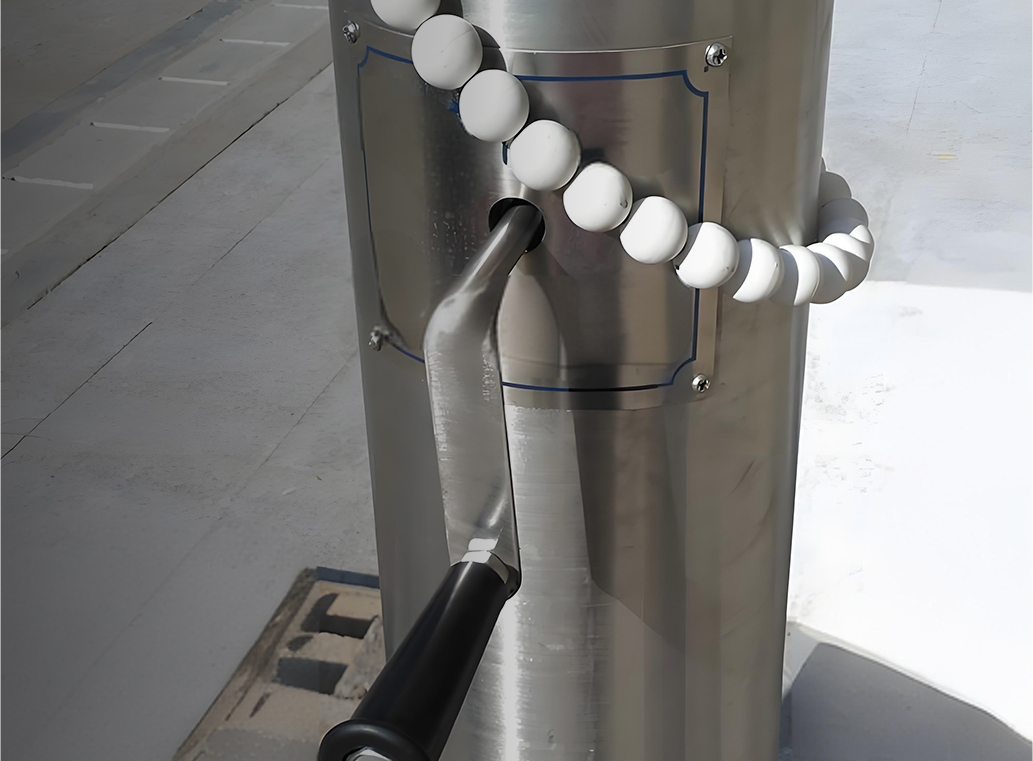
How to keep flag from wrapping on internal halyard Outdoor Flagpoles utilizes a heavy steel, plastic coated counterweight combined with a beaded retainer ring that encircles the lower shaft, maintaining constant downward tension on the flag’s trailing edge and tracking securely along the pole profile regardless of wind turbulence. These configurations prove essential for high security, low maintenance commercial properties.
Hanging a Flag on a Flagpole: Rigging Hardware, Knots, and Step-by-Step Procedures
Proper rigging ensures even distribution of wind loads across the flag heading while minimizing mechanical noise and hardware deterioration. Following standardized procedures preserves flag integrity and operational safety.
Rigging Hardware Selection and Material Specifications
Hanging a flag on a flagpole requires heavy duty marine grade snap hooks manufactured from solid brass or stainless steel to withstand constant cyclic loading, paired with UV resistant neoprene or rubber snap covers that slide over the hooks to eliminate annoying metallic clanging noises against the aluminum shaft during windy conditions. High quality hardware selections reduce maintenance intervention intervals.
Step-by-Step Rigging and Tension Optimization
Hanging a flag on a flagpole follows a precise sequence: secure the upper snap hook to the halyard using a reliable loop knot, attach it to the top flag grommet, extend the flag downward to locate the bottom grommet positioning, attach the second snap hook via a adjustable clove hitch, and apply approximately 5 to 10 pounds of vertical tension before securing the halyard to the master cleat. Proper tensioning prevents center fabric sagging and uneven wear.
- Lower the halyard system completely to access hook attachment points comfortably.
- Inspect the rope integrity for signs of fraying, UV degradation, or core rot.
- Form a secure loop in the halyard and pass it through the eye of the top snap hook.
- Clip the top hook into the upper brass grommet of the reinforced flag heading.
- Unroll the flag fully while checking for proper directional orientation.
- Attach the lower snap hook to the halyard adjusting distance to match the bottom grommet.
- Hoist the flag smoothly to the peak while checking for clearance from building obstructions.
- Secure the halyard rope around the cast cleat using a series of interlocking figure-eight wraps.
What Is a Flagpole Sitter: Historical Context, Endurance Records, and Structural Impacts
Flagpole sitting represents a fascinating cultural phenomenon that intersected with mid-20th century engineering, urban advertising, and structural performance testing.
The Origins and Cultural Evolution of Flagpole Sitting
What is a flagpole sitter defines an individual participating in the widespread 1920s endurance fad where stunt performers climbed specially modified shafts to sit on small wooden platforms for extended durations, serving as spectacular advertising attractions for hotels, theaters, and amusement parks looking to draw massive crowds.
Outdoor Flagpoles: Comprehensive Selection, Material Science, and Installation Logistics
Specifying Outdoor Flagpoles for commercial, municipal, or high-end residential properties requires assessing material science, soil dynamics, and local zoning limitations.
| Performance Property | Standard Aluminum | Heavy Duty Aluminum | Premium Fiberglass | Structural Steel |
|---|---|---|---|---|
| Tensile Strength (PSI) | 30,000 to 35,000 | 38,000 to 45,000 | 40,000 to 50,000 | 60,000 to 75,000 |
| Weight per Foot (lbs) | 2.5 to 4.0 | 5.0 to 8.0 | 1.8 to 3.0 | 10.0 to 15.0 |
| Max Wind Speed (MPH) | 85 to 100 | 120 to 150 | 90 to 115 | 130 to 160 |
| Corrosion Resistance | Excellent | Excellent | Outstanding | Moderate |
| Electrical Conductivity | High | High | Zero (Inert) | High |
| Average Lifespan (Years) | 20 to 30 | 35 to 50 | 25 to 40 | 15 to 25 |
| Relative Cost Index | 1.0 (Baseline) | 1.8 to 2.5 | 1.3 to 1.6 | 2.2 to 3.0 |
Frequently Asked Questions Regarding Commercial and Industrial Outdoor Flagpoles
Q1
What size flag should be paired with a 20 ft flagpole for commercial properties?
For standard commercial or residential 20 ft flagpoles, the industry standard and safest flag size is 3 feet by 5 feet. This dimension balances visibility with safe aerodynamic drag loading. If the flagpole is specified as a heavy-duty commercial model with an increased wall thickness and larger butt diameter, a 4 foot by 6 foot flag may be safely used. Flying a flag larger than 4x6 feet on a 20 ft shaft creates excessive overturning moments that can warp or snap the aluminum housing during high wind storms.
Q2
What are the main mechanical causes behind flags wrapping around Outdoor Flagpoles?
Flags wrap around poles primarily due to the failure or absence of a rotating truck assembly at the peak. Stationary trucks use fixed pulleys that cannot adapt to shifting wind directions, forcing the flag fabric to spiral around the shaft when wind currents reverse. Other contributing causes include inadequate halyard tension, the absence of a proper counterweight on internal halyard systems, and using lightweight flags that lack the gravitational inertia needed to resist upward wind currents.
Q3
How often should rigging hardware like snap hooks and halyard ropes be replaced on Outdoor Flagpoles?
On commercial installations, halyard ropes should be thoroughly inspected annually and replaced every 2 to 3 years, as constant UV exposure and friction wear down rope cores. Solid brass or stainless steel snap hooks generally last 5 to 7 years, but should be replaced immediately if the spring-loaded gate shows binding or metal pitting. Replacing the neoprene snap covers every 2 years is highly recommended to maintain effective noise dampening.
Q4
Why did flagpole sitting vanish as a popular public event after the 1930s?
Flagpole sitting lost popularity due to the convergence of the Great Depression and changing public safety regulations. As the economic crisis deepened, corporate sponsors withdrew funding for novelty promotional stunts, favoring direct value advertising. Concurrently, municipal authorities began enforcing stricter building codes and liability laws, classifying unsupervised flagpole perches as dangerous public hazards, which effectively ended the era of commercial endurance stunts.
Q5
Is an internal halyard system superior to an external halyard system for industrial Outdoor Flagpoles?
Yes, internal halyard systems are highly superior for industrial and high-security settings. By routing the rigging inside the hollow shaft behind a lockable flush access door, internal systems protect the halyard from vandalism, theft, and severe weather degradation. Furthermore, internal configurations utilize counterweights and retainer rings that greatly reduce flag wrapping and eliminate the loud rope clanging noise common to external cleat setups.